

Türkiye FSRU Regasification System — Seawater Piping
Client /A Türkiye FSRU operator
Location /Brazil (survey), Shenzhen (manufacture), Türkiye (installation)
Date /2025 (completed within the FSRU's berth window)
⚓ Offshore regasification unit · pipe-renewal project
Project Background
A large floating storage and regasification unit (FSRU) in Türkiye needed its seawater piping renewed, including the critical cooling lines of the regasification module. After years in a high-salinity, high-humidity marine environment, the original pipework had developed serious internal corrosion and leaks — a direct threat to safe operation. The operator searched worldwide for a supplier of highly corrosion-resistant, high-precision prefabricated pipe to replace the traditional on-site fabrication approach.
With the FSRU's schedule tightly booked, the pipe replacement had to be completed within a fixed berth window — any delay would be hugely costly. That demanded not only excellent product quality but also precise remote-survey capability and reliable global logistics.
Challenges & Requirements
The project faced three core challenges:
Complex geometry & demanding accuracy
The pipework was geometrically complex, with many non-standard elbows, tees and reducers; copying the old pipe the traditional way was slow and could not guarantee accuracy.
Distorted old pipe, impossible to survey directly
The old pipe was so corroded that some joints had distorted, so it could not serve as a physical template — the traditional method failed.
Cross-continent, hot-work-free, zero-error assembly
The project spanned three continents — survey in Brazil, manufacture in China, installation in Türkiye — where any dimensional error could prevent on-site assembly, and no hot work was possible there.
The client was explicit: the new pipe had to achieve100% prefabrication, fit-on-arrival and zero on-site modification, at a competitive cost.
The Irwin Solution
To meet these challenges, the Irwin team devised an integrated"digital survey + centralised prefabrication + global delivery"approach. First, Irwin technicians used the Automet® digital survey system on the FSRU in Brazil to make a high-precision 3D scan of the in-service pipe, capturing as-built dimensions for every spool without removing the old pipe or relying on original drawings.
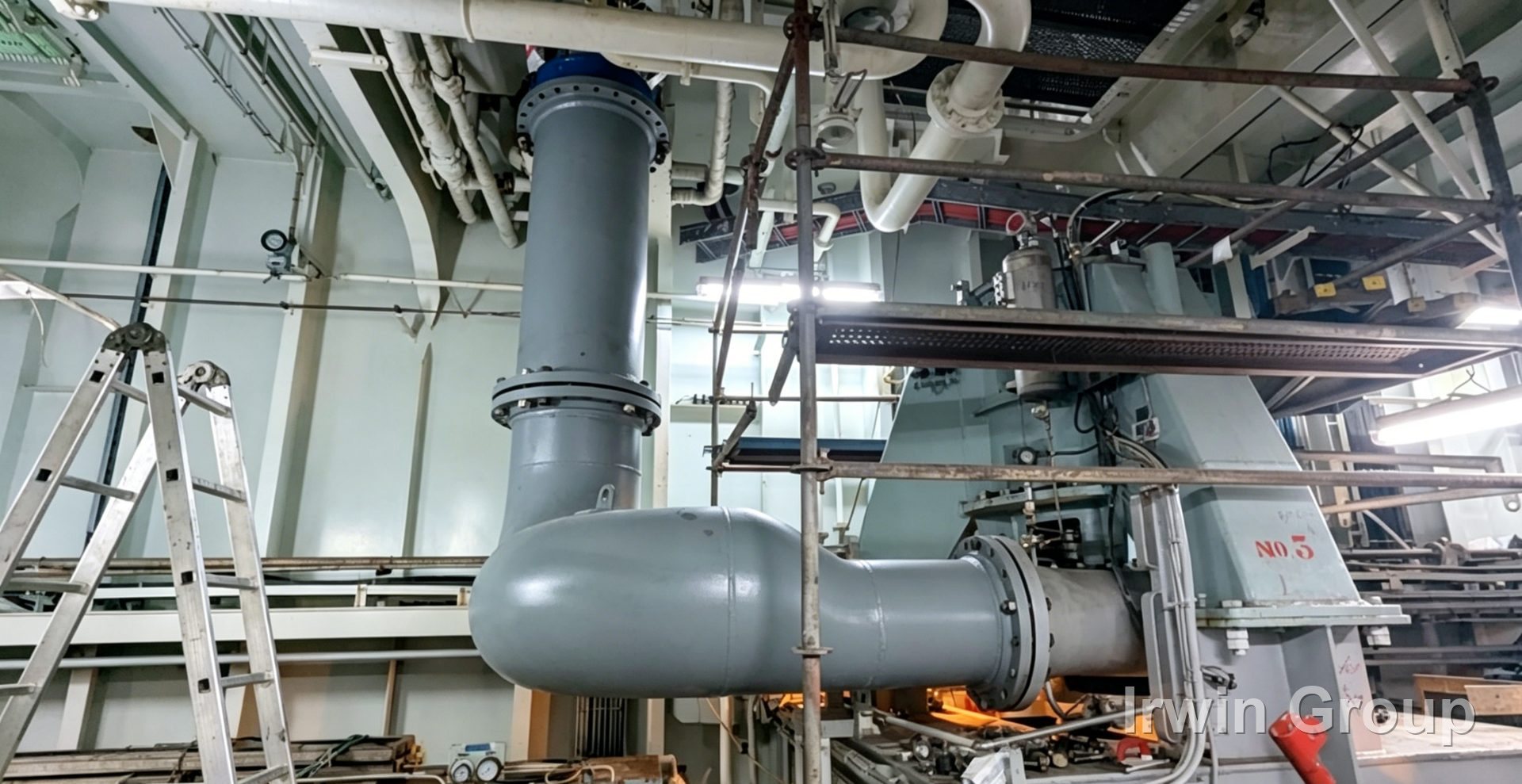
The survey data captured in Brazil was transmitted across borders to Irwin's Shenzhen engineering centre and turned into a 3D digital model and manufacturing isometrics. From the model the workshop CNC-cut, fitted and rotary-welded each spool with post-weld dimensional checks; spool interiors received rotary PE lining for fully sealed corrosion protection and exteriors were blasted and industrially coated — ready to bolt straight up on arrival in Türkiye.
After independent QC and pressure testing, all the prefabricated spools were packed and shipped by sea to the Türkiye yard. From survey in Brazil to installation in Türkiye, the whole flow formed a digital-model-driven closed loop — with no on-site measuring, cutting or welding on the FSRU.
Process
The full project workflow:
Results
Every prefabricated spool was installed in a single pass on site, with flange faces precisely aligned and no misalignment or trimming required.
Versus new-build at a local Türkiye yard, the client's total procurement cost fell by about 50%
From survey in Brazil to delivery in Türkiye in 6 weeks — fully matching the FSRU's berth plan with no delay
Every spool carries a 5-year drydock-to-drydock warranty, with PE lining expected to last over 15 years
✅ 100% first-time fit — all the spools with flanges perfectly aligned, no misalignment, no trimming.
✅ Major cost saving — total procurement cost reduced by about 50%.
✅ Schedule matched precisely — 6-week global delivery, zero delay.
✅ Lasting quality — 5-year drydock warranty, with PE lining designed to last over 15 years.
Client Value
This project proved out a cross-continent renewal model — survey in one country, prefabrication in China, installation in another; the client gained a seawater-piping system beyond new-build standard at a cost far below the local yard, and a new offsite-prefabrication delivery approach —"digital survey, remote prefabrication, global delivery". The model avoids the quality variation and schedule risk of traditional on-site hand-work and old-pipe copying — a repeatable benchmark for future piping upgrades on FSRUs and floating units.